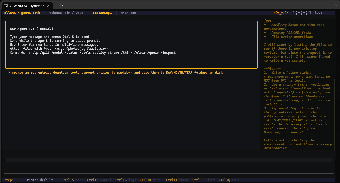
Python framework for customizable AI coding agents and tooling
aar, created by Fischerf, is a Python-based AI coding agent and framework for building and running programmable agents that interact with codebases and external tools. The app exposes CLI, interactive TUI, and a Web API so developers can run one-shot automations, interactive chats, or serve agent behavior over HTTP. Key capabilities include native MCP and ACP protocol support plus a pluggable Python extension system. It targets developers and researchers who need an inspectable, extensible agent platform for custom workflows.
What tasks can you actually use it for?
The tool handles both interactive and automated developer tasks, with explicit modes for one-shot automation, conversational CLI loops, terminal UI sessions, and a web-serving mode. It supports an ACP mode for IDE integration and can act as an agent that edits code, runs diagnostics, or calls external tools via configured providers. That makes it suited for scripted automation, iterative code assistance, and lightweight service endpoints rather than general consumer chat use.
How dependable are outputs across different models?
Outputs depend on the chosen provider and runtime: the app is provider-agnostic and can target Anthropic, OpenAI, Gemini, or local inference endpoints, so the model selection directly shapes result fidelity. The agent lifecycle includes cooperative and hard cancellation controls to stop long-running tasks, which helps manage runaway generations. Expect variability tied to model choice and prompt design rather than the framework itself.
What input requirements and integration limits exist?
The framework runs on systems supporting Python 3.10 or later and is designed for terminal environments with optional IDE attachment via ACP. It can connect to external MCP servers to load additional tools and can be pointed at local model endpoints by changing the base_url. These constraints mean it fits environments where Python tooling and network-configurable model endpoints are already available.
Does it require technical knowledge to get useful results?
Yes, the extension model is Python-first: custom tools, slash-commands, and system prompts are added as Python modules, so users need coding skills to extend behavior. The package bundles CLI, TUI, and server capabilities without container requirements, which keeps the runtime lightweight but presumes familiarity with Python package installation and terminal workflows when integrating into existing developer toolchains.
A practical choice for developers who prefer open, modifiable agent platforms
The app is a pragmatic option for Python-fluent developers and researchers who prioritize inspectability and extensibility, supported by persistent session logging saved as JSONL for auditing and resumption. Installation currently requires cloning the repository and installing from source, so expect a development-oriented setup. Community discussion on developer forums highlights its lightweight, no-corporate-backing character, making it appealing for experimental or research workflows.